
Job Costing Overview
Job Costing Workflow Overview
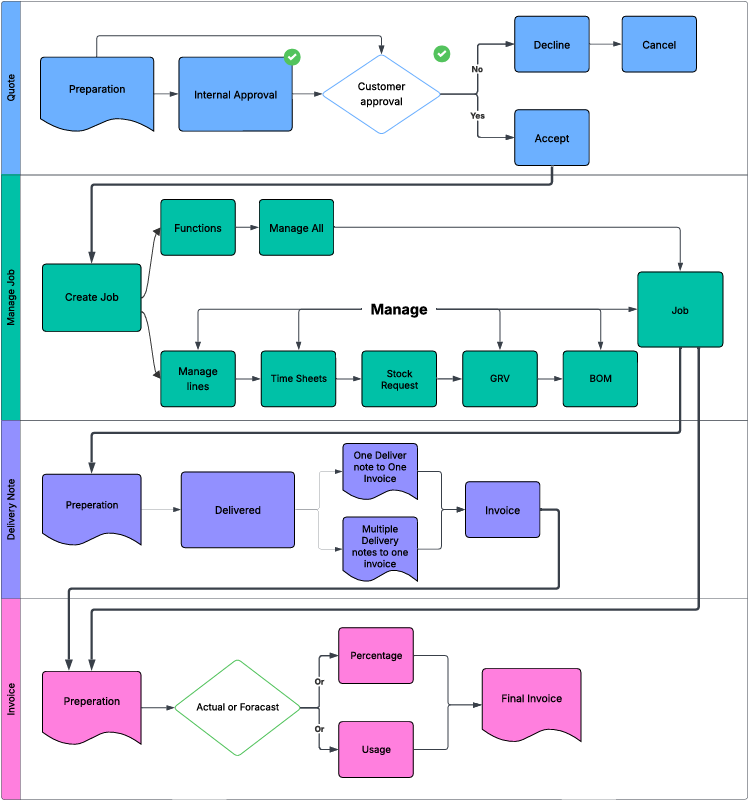
Quote
Every job begins with a Quote, which provides the estimated cost of the work and serves as the basis for customer approval. Once approved, the quote can be promoted to a Managed Job—the central stage where production activities are tracked, coordinated, and monitored.
From there, you have two workflow options:
- Option 1: Proceed to a Delivery Note if items need to be dispatched, followed by an Invoice.
- Option 2: Go directly from Managed Job to Invoice if no delivery documentation is required.
Alternatively, you can initiate a job directly from the Managed Job stage. In this case, the system will automatically generate a corresponding quote, ensuring every job remains linked to a quote—regardless of where it begins.
Invoicing can be structured in two primary formats: percentage-based or usage-based. Each format can be further refined into actual or forecasted (predicted) invoicing. Multiple invoices can be issued under either approach, depending on project needs or billing cycles.
Manage Job
You can initiate a job directly from the Managed Job stage. In this case, the system will automatically generate a corresponding quote, ensuring every job remains linked to a quote—regardless of where it begins.
Delivery Note
Once a job, or part of a job is complete and ready for dispatch, a Delivery Note can be prepared to document the items being sent. This note serves as the formal record of what’s leaving your premises and when.
You can choose between two dispatch-to-invoice workflows:
- One Delivery Note to One Invoice: Ideal for single shipments or straightforward billing.
- Multiple Delivery Notes to One Invoice: Useful for staged deliveries that are consolidated into a single invoice for streamlined billing.
This flexibility ensures your dispatch and invoicing processes stay aligned with the pace and structure of the job.
Invoice
Invoicing can be structured in two primary formats: percentage-based or usage-based. Each format can be further refined into actual or forecasted (predicted) invoicing. Multiple invoices can be issued under either approach, depending on project needs or billing cycles.
- Forecasted vs Actual Invoicing
Invoicing can be structured around two distinct approaches. Forecasted and Actual, each with its own implications for cost control and client expectations.
Forecasted Invoicing - Forecasted invoicing is based on the original
Quote, which outlines the agreed scope and cost. Oncequote accepted by theclient,client.thisThis quotebecomessetsthea fixed financialceilingboundary for the job. Any costs incurred beyond the quoted amount are absorbed by the company, as the client hasapprovedagreed to thequotescope“as-is.”and price upfront. This model is ideal forfixed-priceprojectswhere scope and deliverables arewith clearly definedupfront.deliverables - and minimal expected variation.
Actual Invoicing - Actual
applies tocharge-up jobs, where billinginvoicing reflects thereal-timereal costs incurred duringexecution. While a quote may still be provided as a reference,thefinaljob.invoiceIt’s typically used for charge-up jobs, where billing is based onactualtime,usage, time,materials, ormaterials.usage. If costs exceed the original quote, this istypicallytreated as scopecreep—oftencreep,resultingusuallyfromdue to client-drivenchanges, additions,changes orunforeseen requirements.additions. These adjustments are communicated andbilledinvoiced accordingly.- Percentage-Based Invoicing
Percentage invoicing allows you to bill progressively over the life of a job. It’s especially useful for long-term or multi-phase projects.
- You can issue an invoice before the job starts, based on an agreed percentage.
- Costs are tracked against the quote, allowing you to compare estimated vs actuals.
- This approach helps maintain monthly profit and loss consistency, supporting smoother financial reporting.- Usage-Based Invoicing
Usage invoicing is based on actual items used or consumed during the job.
- Invoices reflect real item costs, similar to a traditional invoice format.
- You can compare quoted item costs and selling prices against actuals and invoiced amounts.
- This model is ideal for jobs with variable scope or evolving material requirements.