
Job Costing Overview
Job Costing Workflow Overview
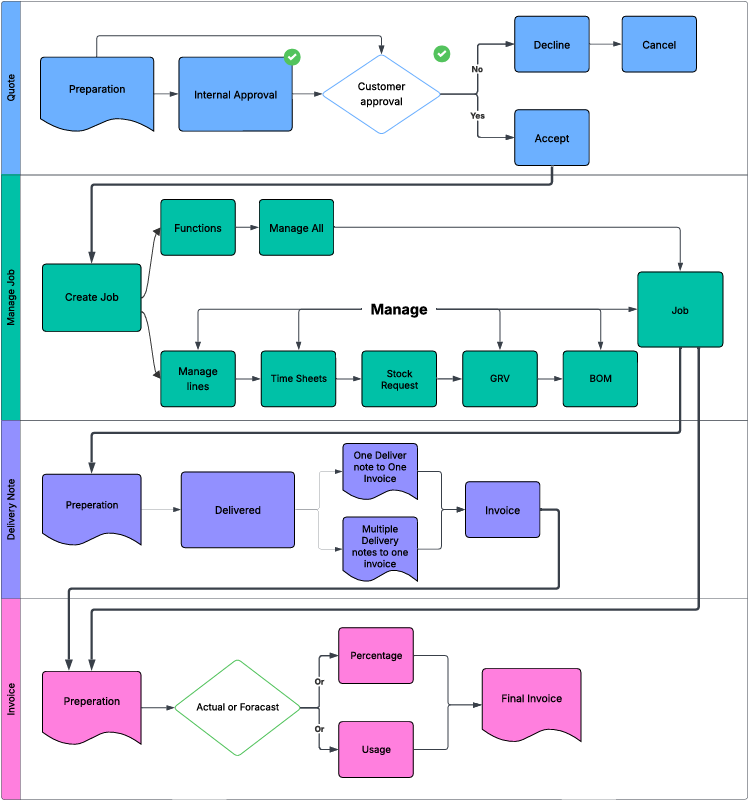
Quote
Every job begins with a Quote, which provides the estimated cost of the work and serves as the basis for customer approval. Once approved, the quote can be promoted to a Managed Job—the central stage where production activities are tracked, coordinated, and monitored.
From there, you have two workflow options:
- Option 1: Proceed to a Delivery Note if items need to be dispatched, followed by an Invoice.
- Option 2: Go directly from Managed Job to Invoice if no delivery documentation is required.
Alternatively, you can initiate a job directly from the Managed Job stage. In this case, the system will automatically generate a corresponding quote, ensuring every job remains linked to a quote—regardless of where it begins.
Invoicing can be structured in two primary formats: percentage-based or usage-based. Each format can be further refined into actual or forecasted (predicted) invoicing. Multiple invoices can be issued under either approach, depending on project needs or billing cycles.
Manage Job
You can initiate a job directly from the Managed Job stage. In this case, the system will automatically generate a corresponding quote, ensuring every job remains linked to a quote—regardless of where it begins.
Delivery Note
Invoice
Invoicing can be structured in two primary formats: percentage-based or usage-based. Each format can be further refined into actual or forecasted (predicted) invoicing. Multiple invoices can be issued under either approach, depending on project needs or billing cycles.
Forecasted vs Actual Invoicing
Invoicing can be structured around two distinct approaches. Forecasted and Actual, each with its own implications for cost control and client expectations.
- Forecasted Invoicing is based on the original Quote, which outlines the agreed scope and cost. Once accepted by the client, this quote becomes the financial ceiling for the job. Any costs incurred beyond the quoted amount are absorbed by the company, as the client has approved the quote “as-is.” This model is ideal for fixed-price projects where scope and deliverables are clearly defined upfront.
- Actual Invoicing applies to charge-up jobs, where billing reflects the real-time costs incurred during execution. While a quote may still be provided as a reference, the final invoice is based on actual usage, time, or materials. If costs exceed the original quote, this is typically treated as scope creep—often resulting from client-driven changes, additions, or unforeseen requirements. These adjustments are communicated and billed accordingly.