
New Stock Order Create
The stock order function allows one to create supplier purchase orders automatically without having to create purchase orders for each supplier individually and adding each item individually.
This feature does require a few setups to be in place for optimum use:
| Default supplier setup on each item | This is so that the system knows which supplier to create the Purchas order against |
| Min / Max quantity levels on each item | Used on some of the options to determine order quantities. |
To Create a new stock order, go to Creditors Module > Activity > Stock Order Search
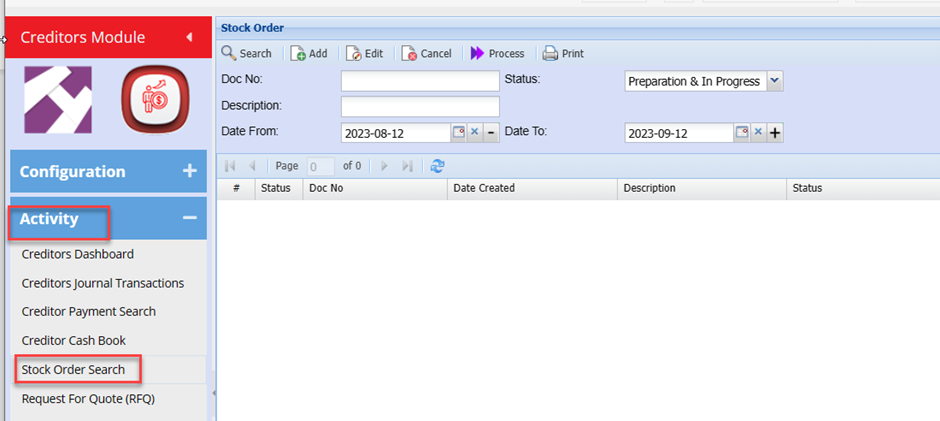
| Search | |
| Add | |
| Edit | |
| Cancel | |
| Process | |
Click Add to create a new Stock Order batch.
There are 2 option to add items to the order batch in bulk:
| Using Brand / Make setup | Using Item Group setup |
|
This is the Brand and Make the item is linked to.
Using this option, selecting a particular Brand, will result in all items linked to the selected Brand being automatically added to the batch without you having to select each item individually. |
This option looks at the Group code the Item is linked to and pulls through all items linked to the selected Group(s).
Click on the Brand Drop down to see the list of Brands. To use the group code option, tick the box “Use Groups”. Double click on the required item Group code in the left (available) box to move the group to the selection box on the right. |
In this example, we are going to create a stock order batch using the item group code “HATS”:
We are not using the Brand/ make setup, thus will leave these unselected.
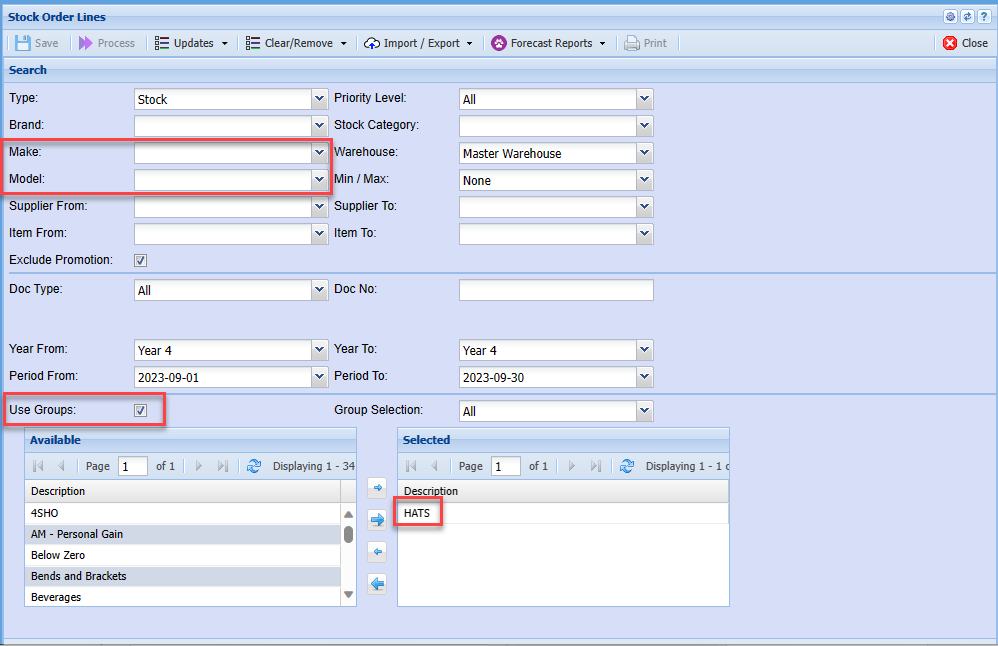
Once the require Brand/ group code(s) have been selected, click on Next
This will open a window with all items linked to Group code, HATS listed in the grid
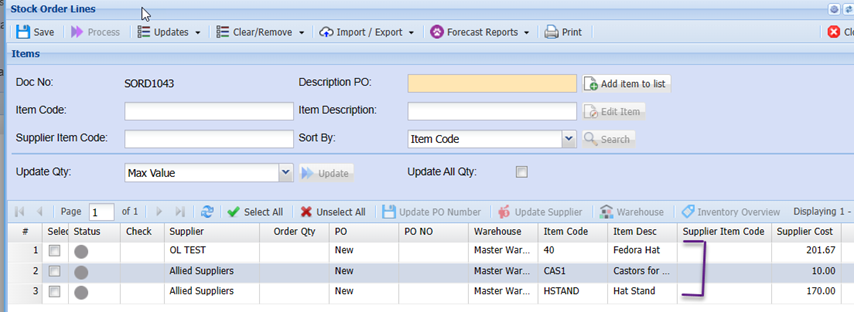
Enter a description that will be used on the Purchase order(s)
This will activate the Update button
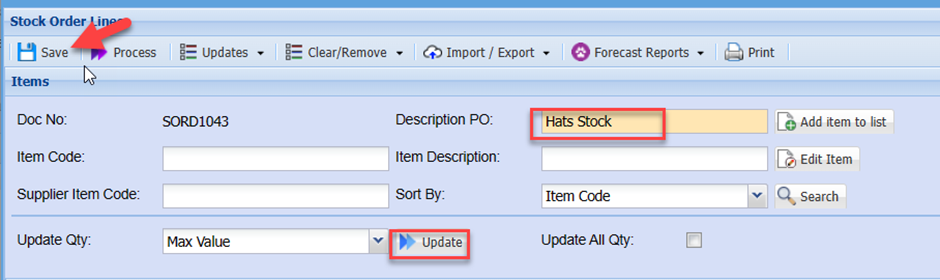
You now need to determine which calculation you wish to apply in order to update the required order quantities for each item.
The order quantities applied to each respective item can be determined from a number of options:
Click the Update Qty drop down to see the list of options:
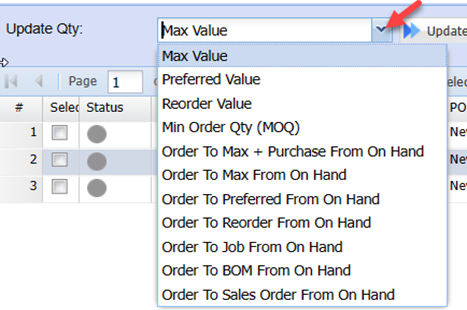
| Max Value | Populates the order quantities to equal the Maximum qty as per item setup |
| Preferred Value | Populate the order quantities to equal the Preferred Quantity as per item setup |
| Min Order Qty (MOQ) |
Will populate the Order Quantities to equal Minimum order quantity as per item setup. Note the Minimum quantity and the Minimum order Quantity are different Minimum quantity is te minimum holding quantity. Minimum order quantity is the minimum quantity that can be ordered from the supplier. |
| Order to Max + Purchase from on hand | Populates the order quantities to be Item Maximum Qty less Qty on Hand less qty on open Purchase orders |
| Order to Max from on hand | The difference between the maximum quantity and the on hand quantity |
| Order to Preferred from on hand | The difference between the Preferred item Quantity and the on hand quantity |
| Order to Reorder from on hand | |
| The difference between the Reorder quantity and the quantity on hand |
In this example, we are going to be using the Reorder from on hand option This will calculate the difference between the Reorder level on the item setup and the current on hand quantity. And update the order quantity on this batch with this difference. |

| 1. | Click the Select All Button |
| 2. | Select: Order to Reorder from on hand |
| 3. | Click the Update button |
| 4. | You will notice the order quantities on the grid have been populated with the respective quantities |
You can then review the quantities to be ordered
Should you wish to override any of the quantities, click the select box
Then click on the order quantity field
Enter the amended quantity
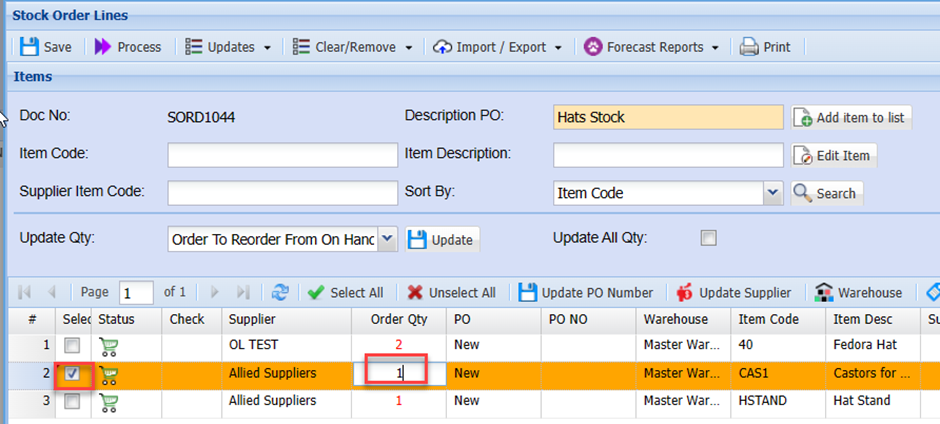
Once you are satisfied with the quantities to be ordered from supplier, click the Process button to create the Purchase order(s)
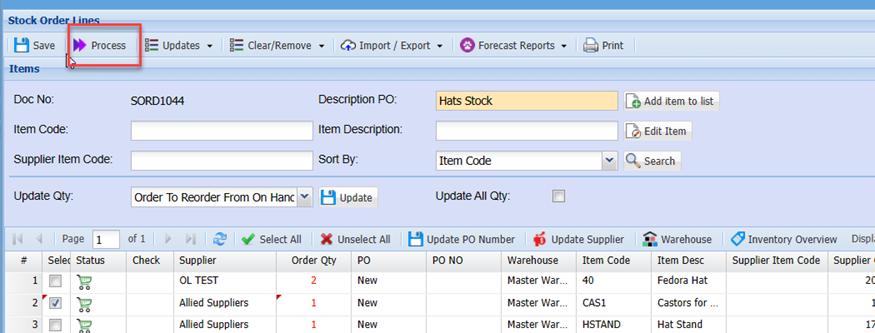
Select Create PO
Click Ok
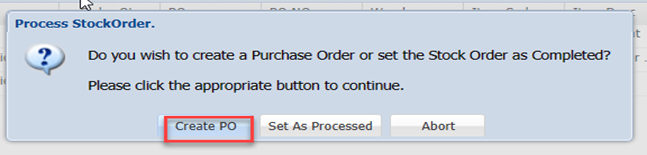
To view the Purchase order:
Go to Activity > Purchase Orders
Search
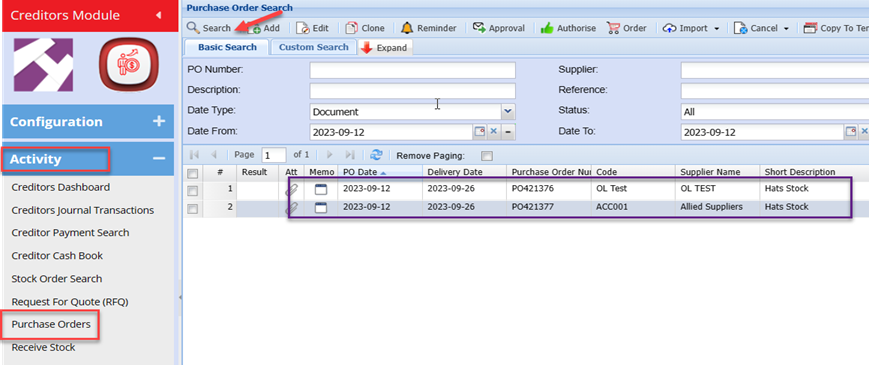
You should now see the purchase orders listed and can process these using the normal purchase order authorisation and order procedures.
Note: you may find several purchase order, this is because a purchase order is created for each of the default supplies (if the items have different default suppliers linked)
You can still edit the supplier and any other details before finalizing the Purchase order.